

What is Culture Fit?
At its core, culture fit refers to how well a candidate’s values, work style, ethics, and interpersonal behaviours align with an organisation’s culture, core ethos and environment. It considers whether the person can support the company’s core values, meet its expectations and work constructively within its existing team dynamics.
A good culture fit does not mean hiring people with similar personalities, backgrounds or beliefs. It means identifying candidates who share the values needed to deliver results while bringing their own experiences and perspectives. Someone can think differently from their colleagues and still demonstrate integrity, accountability, respect and a strong work ethic.
When an employee fits well within an organisational culture, they don’t have to force their day-to-day interactions or struggle against the grain of how things get done. They understand the unspoken norms, communicate effectively with peers, and feel an intrinsic sense of purpose in their role. Also, when cultural alignment is present, a new hire is more likely to understand how the organisation operates, communicate openly and develop a deeper sense of purpose in their role. This can improve employee satisfaction, employee engagement and long-term retention.
Culture Fit vs Culture Add
Culture fit assesses whether a candidate’s values and working style align with the company’s existing culture, while culture add considers the new perspectives, experiences and strengths they could bring. And what strong cultures need is both: shared values create trust and consistency, while diverse perspectives challenge established thinking and help the business evolve. Hiring decisions should therefore focus on cultural alignment without focusing solely on whether potential candidates resemble current team members.
Why Experience Isn’t Everything?
Experience matters, but it cannot guarantee commitment, sound judgement, positive workplace behaviour or the candidate’s ability to collaborate with others. A person with slightly less experience but the right attitude and values may ultimately contribute more than someone whose CV is stronger but whose behaviour conflicts with the organisation’s culture.
Skills Can Be Taught
Hard skills, software proficiency, and operational procedures are inherently trainable, so most processes and procedures can be developed through structured onboarding and support. With ongoing training and a supportive team, a motivated new starter with foundational competence can master the specific technical tools required for a role within weeks or months. A motivated new starter can be trained on software, reporting procedures and organisation-specific ways of working; given enough time and the right support, most competent, motivated people will pick this up. What’s much harder to instil is a genuine work ethic, a collaborative attitude, or a natural alignment with how the organisation treats its people and its work.
This does not mean employers should overlook essential qualifications or specialist experience. In regulated sectors such as health and social care, certain roles require specific credentials and proven competence. Once those requirements are met, however, the recruitment process should also determine whether the candidate demonstrates accountability, curiosity, adaptability and a willingness to learn.
This is why so many experienced hiring managers will choose a candidate with slightly less experience but a strong cultural match over someone who ticks every technical box but doesn’t seem to fit the team. The skills gap closes with training, but the values gap rarely does.
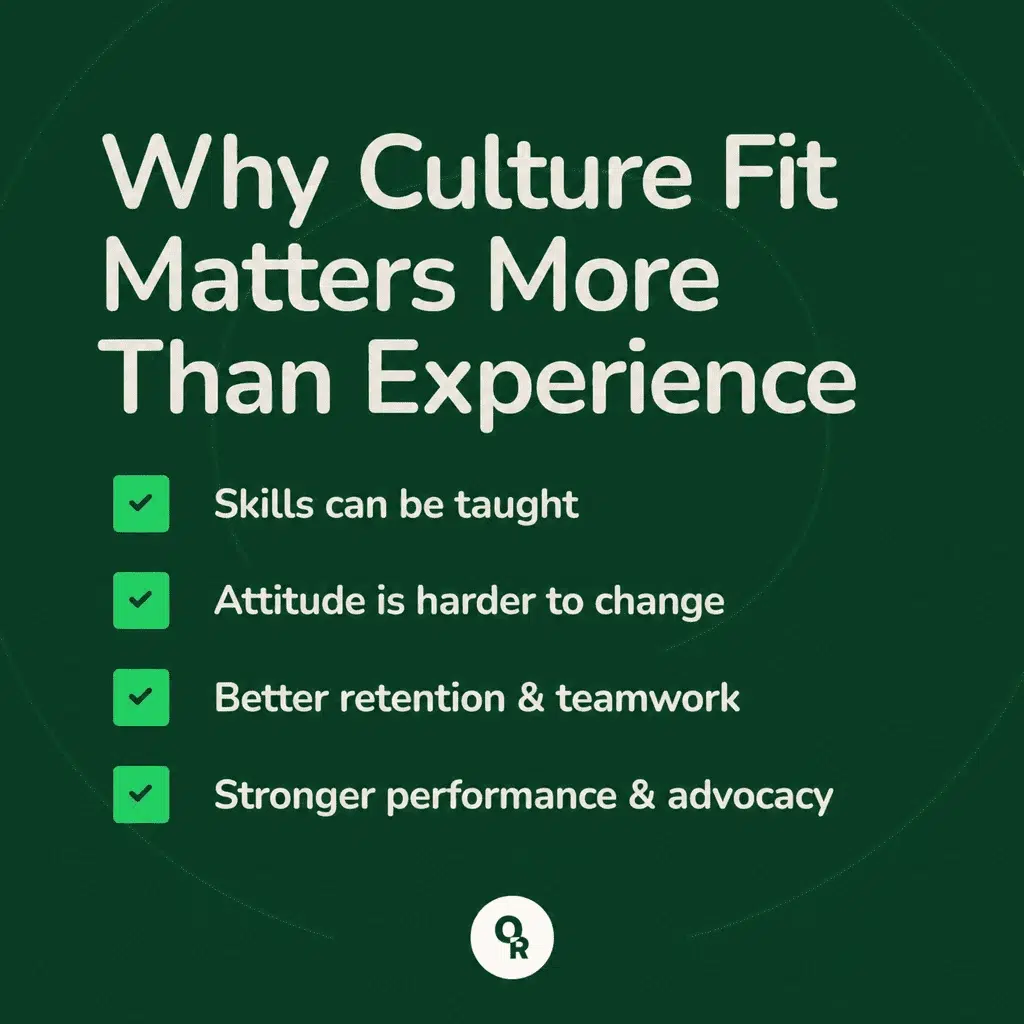
Reasons Cultural Alignment Beats Experience Every Time
Experience may help someone settle into the technical aspects of a job more quickly, but cultural alignment influences how they communicate, make decisions, support colleagues and respond when the work becomes difficult. A good cultural fit can therefore affect everything from individual performance to retention and the quality of the wider workplace.
You Can Train Skills, But You Can’t Teach Attitude
Changing an individual’s fundamental work ethic, integrity, or attitude toward collaboration is nearly impossible. You can send someone on a course to learn a new system or a new process, but you can’t send them on a course to become more honest, more reliable, or more willing to support their colleagues. These are deeply rooted traits that either align with your organisation’s culture, or they don’t, and no amount of experience compensates for a mismatch here.
If an employee is exceptionally experienced but resistant to feedback, toxic to colleagues, or unaligned with the organisation’s mission, their presence can quickly dismantle team morale and disrupt productivity.
Improved Staff Retention
Employees tend to stay longer when they feel respected, included and connected to the company values. Clear cultural alignment can create a stronger sense of belonging, improve work-life balance and reduce the dissatisfaction caused by mismatched expectations. When organisations discuss their values and working environment honestly during the hiring process, candidates can make better-informed decisions and employers are more likely to reduce turnover.
Cultural alignment between a company and its workforce serves as a foundation for open communication and efficient teamwork that deliver above-average results. Individuals who share similar values and work styles are more likely to trust one another and to work together, leading to higher productivity and quicker problem-solving.
Better Performance and Productivity
Culturally aligned teams often benefit from open communication, mutual respect and clearer expectations. Employees who share values around accountability and collaboration can resolve problems more efficiently and concentrate on delivering high-quality work. This supports stronger teamwork, higher productivity and a more consistent ability to achieve results.
- Faster decision-making: Shared values help employees understand organisational priorities, make confident decisions and work with greater independence, reducing unnecessary delays and enabling faster responses.
- Stronger communication and collaboration: Clear expectations and mutual respect reduce misunderstandings and help teams resolve challenges more effectively.
- Greater motivation and consistency: Employees who connect with an organisation’s purpose are often more engaged and committed to delivering high-quality work.
Together, these factors contribute to stronger teamwork, higher productivity and a more reliable ability to achieve results.
Natural Brand Advocacy
A company with a reputation for cultivating a culture that respects diversity, prioritises employee satisfaction, and offers smooth channels for collaboration is more likely to attract top talent than a firm with a poor workplace culture. Employees who genuinely believe in an organisation’s values often become its most credible advocates. This talent can be put to good use reinforcing the company’s position, thereby perpetuating the cycle of satisfaction.
Whether interacting with clients, patients, or prospective talent, their authentic enthusiasm and pride in the organisation speak far louder than any marketing campaign. They speak positively about the organisation, represent it well to clients, families or service users, and often help attract other like-minded candidates through word of mouth. This kind of authentic advocacy can’t be manufactured through marketing alone; it comes from employees who genuinely believe in what the organisation is doing.
What Does Good Culture Fit Look Like?
Good culture fit shows up in a few consistent ways.
- Shared values: a genuine alignment between what personal values matter in their work and what the organisation stands for, whether that’s honesty, accountability, compassion or continuous improvement. A candidate does not need to think or behave exactly like the existing team, but their decisions should be compatible with the organisation’s principles. If compassion, accountability and openness are central values, employers should look for evidence that the candidate has demonstrated them in real situations.
- Positive workplace behaviours: how someone communicates, handles disagreement, supports colleagues under pressure, and takes ownership of their responsibilities. These examples reveal more than personality traits; they are often a far more reliable signal of culture fit than anything a candidate says in an interview. They show how the person is likely to behave when the role becomes challenging.
- Adaptability and a Growth Mindset: a willingness to learn, take on feedback, and grow alongside the organisation rather than expecting the organisation to adapt entirely around them. Candidates who combine shared values with the right behaviours and openness to growth tend to become among the strongest long-term hires.
Why Culture Fit is Especially Important in Health and Social Care
In health and social care, culture fit isn’t just a nice-to-have internal business matter. It directly affects the people receiving support and the overall quality of care delivered. Consistent values across a team lead to consistent care. Compassion, dignity, safeguarding, reliability and person-centred practice must be present in everyday decisions, communication and care delivery, rather than existing only as words in a policy. Service users and their families receive a consistently high standard of person-centered care when care workers, nurses, and managers share core values such as empathy, compassion, and respect, rather than experiencing inconsistent standards depending on who’s on shift.
Consistent values lead to more consistent care. When employees share clear expectations around quality, communication and responsibility, they are better equipped to work together and maintain trust with individuals, families and colleagues. An experienced candidate whose attitude conflicts with those responsibilities can pose risks to team stability, compliance, and service quality. A candidate with the essential qualifications, strong values and a willingness to develop may become a far more dependable long-term employee. Experience may secure an interview, but culture fit often determines long-term success in this sector more than almost any other.
How to Assess Culture Fit (Without Relying on “Gut Feeling”)
Assessing cultural alignment shouldn’t rely on instincts about whether the hiring manager personally would “like to grab a coffee” with an applicant. Unstructured hiring decisions can introduce unconscious bias and disadvantage candidates who communicate differently or bring new perspectives. Avoiding bias requires clear criteria, structured interview questions and evidence-based scoring. Culture fit can feel subjective, but it doesn’t have to come down to instinct alone. With the right approach, it can be assessed just as rigorously as technical skills. A defined process makes the assessment fairer and more useful.
Step 1: Define Your Core Values First
You cannot hire the right person for culture fit if your organisational values are simply generic words displayed on a wall. Define the specific behaviours that represent each value in practice. For example, if “accountability” is important, establish what accountable communication and decision-making should look like in the role. If “integrity” is a core value, define what that looks like in action: admitting mistakes immediately, protecting confidential data, and delivering on promises to service users.
Instead of simply listing “teamwork” as a value, determine what open communication, shared responsibility, and effective teamwork should look like in day-to-day operations within your organisation, so it becomes something you can genuinely interview and assess.
Step 2: Use Behavioural & Situational Questions
Once your values are clearly defined, behavioural and situational interview questions are among the most effective ways to assess cultural fit in practice. Ask every candidate the same core behavioural and situational interview questions that encourage them to describe how they have acted in relevant situations. These might explore how they responded to a safeguarding concern, managed disagreement, received critical feedback, supported a colleague under pressure or adapted when priorities changed. Assess each answer against predefined behaviours so that evidence, not familiarity or similar personalities, guides the hiring decision.
Culture fit should not depend on one person’s opinion. Where practical, involve several team members in the interview process, or conduct a second interview to explore cultural alignment in greater depth. Comparing structured feedback from multiple interviewers can provide a fairer view of the candidate’s ability, communication style, and potential contribution to the team.
Don’t use generic interview questions and ask candidates to share real examples of how they handled past challenges. Questions like “Tell me about a time you had to deliver difficult news to a colleague” or “How do you respond when team priorities change unexpectedly?” reveal a candidate’s true attitude, communication style, and problem-solving framework under pressure.
Their answers show you not just what they say they believe in, but how they actually behave when it matters.
Find Culture Fit in Health and Social Care with Olive Recruit
Finding candidates with both the right qualifications and genuine cultural alignment can be challenging, particularly in health and social care, where values, judgement and behaviour directly influence the quality of support people receive.
At Olive Recruit, the recruiting process begins with a detailed vacancy consultation. Our dedicated consultants take the time to understand the role’s responsibilities, essential requirements, service environment, team dynamics, company culture, leadership expectations and current challenges. This allows us to establish clear, role-specific criteria for assessing candidates, rather than relying on a generic job description or subjective impressions.
This approach is reflected in feedback from a senior HR leader at Catalyst Care Group:
“Olive Recruit is aligned in supporting us to achieve these goals.”
Their experience highlights how Olive Recruit took the time to understand not only the organisation’s recruitment needs, but also the importance of finding people who shared its values and believed in its vision. Read the full testimonial and explore more Olive Recruit Successful Stories.
Our recruitment process combines multi-channel candidate attraction with proactive searches across our database, job boards, LinkedIn, professional networks and referrals. Before presenting a candidate, we assess their employment history, qualifications, motivations, career aspirations and working preferences. We also explore their communication style, leadership approach, safeguarding knowledge and response to realistic workplace situations, while clarifying employment gaps and significant career transitions.
Most importantly, we take the time to understand the person behind the CV. Our consultant interviews explore whether a candidate’s values and behaviours align with the organisation while recognising the different perspectives and strengths new members could bring to the team. Combined with candidate preparation, interview coordination, regular communication and feedback management, this helps Olive Recruit connect health and social care employers with qualified professionals who can uphold their values, strengthen their teams and contribute over the long term.
