

What Makes a Social Care Role Difficult to Recruit?
A social care role becomes difficult to recruit when demand exceeds the supply of candidates with the necessary qualifications, experience, and professional competence, and genuine skills shortages are only part of the explanation. An unclear role, an uncompetitive salary, unrealistic expectations or a slow recruitment process can make an already limited candidate pool even smaller.
Values-based recruitment can help organisations identify people whose motivations and behaviours align with person-centred support. However, values cannot replace essential qualifications, safeguarding knowledge or technical competence. Successful recruitment brings together the right skills, values and potential for continued professional development.
The most common barriers in the adult social care sector include:
- A limited talent pool: Providers are competing for a relatively small number of experienced and appropriately qualified candidates.
- Specialist training requirements: Some positions require professional registration, advanced qualifications or service-specific experience that takes years to develop.
- Complexity and accountability: Clinical, safeguarding, regulatory and operational responsibilities are not always reflected in the title, salary or support attached to the role.
- Competition from the NHS and other sectors: Candidates may have access to better-known career pathways, pensions, structured pay bands or more flexible opportunities elsewhere.
- Geographical and transport barriers: Rural locations, limited public transport and travel between services can exclude otherwise suitable candidates.
- Demanding working arrangements: Nights, weekends, on-call duties, lone working and emotionally demanding situations can undermine work life balance and affect both recruitment and retention.
- A largely passive candidate market: Many experienced specialists are already employed and may only explore a move when the opportunity offers a clear improvement.
- Slow recruitment and onboarding: Delayed feedback, excessive interview stages and inconsistent communication can cause strong candidates to accept another offer.
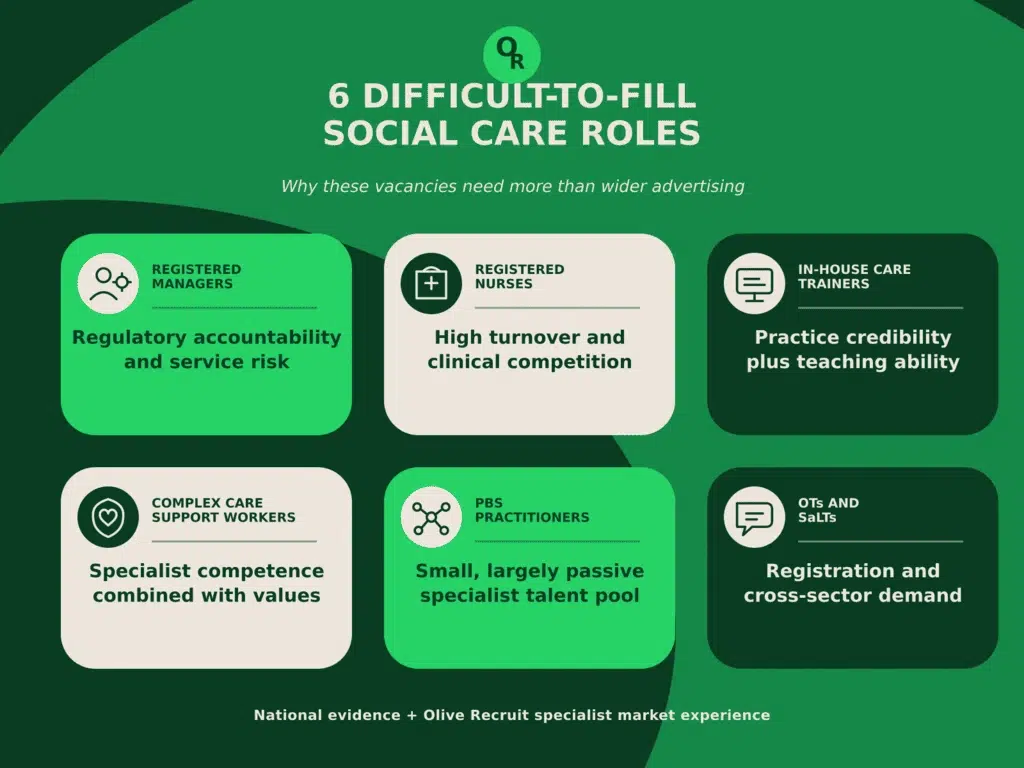
Although these challenges can affect recruitment across the adult social care sector, they are often more pronounced in certain roles. The six roles below have been selected for closer examination using workforce evidence, regulatory requirements and Olive Recruit’s placement experience.
1. Registered Managers
Registered Managers are among the clearest examples of a difficult-to-fill social care role. According to Skills for Care’s 2024/25 workforce data, the Registered Manager vacancy rate in England was 11.4%, compared with 7% across adult social care overall.
The role carries substantial operational and regulatory accountability. A Registered Manager is responsible for day-to-day service delivery, managing staff and budgets, overseeing safeguarding and quality, responding to inspections and ensuring that regulatory requirements are met. The Care Quality Commission additionally confirms that the manager shares legal responsibility with the provider for compliance with the relevant regulations.
Experienced candidates usually do not assess salary in isolation. They want an honest account of the service’s regulatory history, staffing stability, safeguarding position, use of agency workers, on-call expectations and improvement priorities. They also need to know whether they will have the authority, resources and senior leadership support required to succeed.
So, what is the recruitment priority? – Present the service as it is, not as the employer hopes it will appear. A credible brief will attract fewer unsuitable applications and give experienced managers a stronger reason to engage.
Leona Blenman, General Manager at Olive Recruit, explains:
“Registered Manager roles carry a level of responsibility that cannot be captured by the job title alone. Experienced candidates want clarity about the salary, the condition of the service, the expectations placed on them and the support they will receive from the provider. When the package and scope do not reflect the accountability involved, organisations can lose strong candidates before the recruitment process has properly begun.”
2. Registered Nurses in Social Care
The recruitment picture for social care nursing is more nuanced. Latest data confirms that the independent-sector nursing vacancy rate fell from 14.5% in 2021/22 to 6.7% in 2024/25. However, turnover remained high at 32.8%, equivalent to approximately 9,700 leavers. Recruiting and retaining staff are therefore closely connected challenges; providers must create conditions in which nurses want to remain.
Social care nurses often work with considerable independence while managing medication, deterioration, clinical risk and long-term or complex health needs. They may also coordinate with families, GPs, social workers, community teams and other professionals. Candidates will assess staffing levels, clinical escalation arrangements, NMC revalidation support, pension provision, rotas and access to career progression through professional development.
So, what is the recruitment priority? – Sell the full employment proposition, not simply the hourly or annual rate. If the rota, workload or clinical support is unsustainable, salary alone will not secure long-term retention.
3. In-House Trainers
In-house care trainers occupy a narrow talent market because the role requires two distinct strengths. They need current health and social care knowledge, but they must also be able to teach, assess competence and translate policy into safe everyday practice.
A highly experienced practitioner is not automatically an effective educator. Equally, a polished trainer may lack the frontline credibility needed to engage teams supporting people with complex needs. Olive Recruit also sees employers combine several responsibilities under the same title: course delivery, content design, practical assessment, compliance reporting, coaching and travel between services. When the salary and resources do not reflect that scope, experienced trainers may prefer independent consultancy and flexible day rates. The job description should state whether the trainer will deliver established programmes or build the learning function, how much travel is involved, which competencies they will assess and what administrative support is available.
So, what is the recruitment priority? –Define the role before pricing it. Employers that advertise an operational trainer, learning designer, assessor and compliance lead as one ordinary training vacancy will narrow an already limited candidate pool.
4. Specialist Complex Care Support Workers
Specialist Complex Care Support Workers may support autistic adults, people with a learning disability, acquired brain injuries, mental health needs, behaviours of concern or complex clinical conditions. Depending on the service, the work may require knowledge of trauma-informed practice, Positive Behaviour Support, de-escalation, medication, specialist communication or clinical interventions.
The Catalyst Care Group Outcomes Report 2025 illustrates the breadth of practice that complex care teams may apply, including autism-informed support, trauma-informed care, PBS and PROACT-SCIPr-UK®. This is an organisation-specific example of role complexity, not a national measure of candidate scarcity. The recruitment mistake is often made at one of two extremes. Hiring solely on availability can create safeguarding, quality and retention risks. At the other end, requiring every specialist skill on day one can exclude candidates with strong values, relevant transferable experience and the capacity to develop safely.
Providers should separate non-negotiable first-day competence from skills that can be developed through structured, service-specific training. They should also be transparent about rotas, travel, lone working, team support and the emotional demands of the service.
So, what is the recruitment priority? – Build the person specification around risk, not a wish list. Retain essential safeguarding and competence requirements while creating a credible pathway for learning the service-specific elements.
5. PBS Practitioners
PBS Practitioners require behavioural knowledge, functional assessment, data analysis, support plan development, coaching and multidisciplinary collaboration. They must be able to turn evidence and recommendations into consistent everyday practice across care teams. The appropriate qualifications and experience depend on the role’s seniority and the service model. Employers may seek relevant postgraduate study, development aligned with recognised PBS competency frameworks and evidence of applying PBS in complex settings. Because many established practitioners are already employed, a job advert alone may produce limited response.
Candidates will want to understand the quality of clinical supervision, caseload size, travel, available resources, professional development and whether the organisation is genuinely committed to PBS. A provider cannot credibly recruit a practitioner to improve practice while denying them the time or influence needed to do so.
Ashleigh Goodman moved into a PBS Practitioner role after five years as a PBS Specialist. She was looking for deeper expertise, progression, further qualifications and a competitive salary. Olive Recruit maintained regular contact, while Katerina discussed her experience, helped her prepare for both interview stages and reinforced the value of her background.
After joining, Ashleigh said:
“Now that I am in the role, I feel it is a great professional and cultural fit because the organisation is genuinely committed to delivering high-quality, person-centred support. The role allows me to use my PBS knowledge and experience to support teams, improve practice and help create positive outcomes for individuals. It is rewarding to know that my work contributes to improving quality of life and helping people achieve their goals.”
So, what is the recruitment priority? – Show how PBS is supported in practice. Supervision, realistic caseloads and organisational commitment are part of the candidate proposition, not details to discuss after offer.
6. Occupational Therapists and Speech and Language Therapists
Occupational Therapists and Speech and Language Therapists play different professional roles, but they share several recruitment pressures in social care. Both require approved qualifications and registration with the Health and Care Professions Council. They are also recruited by hospitals, community health teams, schools, children’s services, local authorities, charities and private practices.
Social care providers may offer therapists the opportunity to work closely with people over time, influence multidisciplinary practice and see how interventions affect daily life. However, the role becomes less attractive when professional supervision is weak, peer contact is limited or operational demands leave insufficient time for assessment, intervention and outcome monitoring. Employers should be precise about the population supported, geographical coverage, expected caseload, multidisciplinary relationships and access to discipline-specific supervision. Occupational Therapy and Speech and Language Therapy should not be treated as interchangeable simply because both sit within a wider therapy function.
So, what is the recruitment priority? – Protect professional practice. Candidates need to see how they will maintain their registration, develop their expertise and deliver meaningful work without becoming professionally isolated.
Key Challenges to Effective Recruitment in the Social Care Sector
Although every difficult-to-fill role presents specific challenges, several structural pressures affect recruitment across the sector. These pressures are intensified by staff shortages and growing demand associated with an ageing population. Together, they influence whether candidates enter social care, accept a particular opportunity and remain after joining.
Wage Competition & Uncompetitive Pay
Social care does not compete for candidates only with other care providers. It also competes with retail, hospitality, customer service and logistics, sectors that may offer comparable pay for roles carrying different levels of physical, emotional and regulatory responsibility. For many social care staff, low pay remains a significant concern, particularly when earnings do not reflect the demands of the work.
Olive Recruit’s proprietary analysis in the Salary Guide 2026 identifies a further pressure: more than 65% of direct care roles sit within 10% of the National Living Wage. That statutory rate increased to £12.71 in April 2026.
As the wage floor rises, salaries for experienced, specialist and supervisory staff do not always increase at the same pace. The result is wage compression: when the financial difference between a frontline position and one carrying additional qualifications, accountability or on-call responsibility becomes too small, progression can begin to feel less worthwhile.
Leona Blenman explains:
“Pay remains one of the biggest challenges in health and social care, particularly when people feel that the responsibility and emotional demands of their work are not reflected in what they earn. When other roles can offer similar pay with considerably less pressure, care providers are not only competing with one another for employees; they are competing with the wider labour market. For experienced care professionals, feeling valued matters, and pay is inevitably part of that.”
Lack of Recognition & Professional Status
The perception of care as “low-skilled” overlooks the judgement, emotional intelligence, safeguarding awareness and practical competence that people working in the sector need to provide safe, high-quality support. Without visible recognition, credible development pathways and fair progression, experienced social care workers may decide that their contribution will be valued more highly elsewhere, while the next generation may not see the sector as a sustainable career choice.
The Government’s decision to establish the first Adult Social Care Negotiating Body acknowledges longstanding concerns about pay, working conditions, training and progression. However, negotiations are expected to begin in April 2027, with the first settlement due by April 2028. Providers therefore still need to address immediate attraction and retention pressures.
Working Conditions & Travel Logistics
Night shifts, weekends, split shifts, on-call responsibilities and unpredictable working patterns can significantly narrow the talent pool. Home care and community-based positions may also require a driving licence and access to a vehicle, excluding otherwise suitable candidates.
The Catalyst Care Group whitepaper survey of more than 150 respondents offers directional, organisation-owned insight rather than nationally representative research: 33.9% of participating healthcare assistants identified supporting people with multiple needs as a challenge, the same proportion cited staff turnover or rota instability, and more than one-third reported travelling over 30 miles for a shift. These findings illustrate why providers need to explain working patterns, travel expectations and available support honestly from the beginning.
Employers therefore need to consider not only whether someone can perform the job, but whether the working arrangements make it sustainable. Interest may improve when rotas, travel, on-call expectations and available support are explained honestly from the beginning.
Lengthy Onboarding
DBS screening, employment references, right-to-work checks, professional registration and other compliance requirements can extend the period between offer and start date. Specialist appointments may also require verification of qualifications, training records and role-specific competence. These checks are essential. Candidate loss usually occurs when the process lacks clear ownership, realistic timescales and consistent communication, not because the checks themselves are unnecessary.
Pre-employment checks and candidate engagement should begin as soon as the offer is accepted. Candidates need clear instructions, regular progress updates and a named contact. The recruitment partner and internal team should work as one coordinated process, maintaining interest while ensuring that every safeguarding and compliance requirement is completed properly.
How Olive Recruit Can Help Social Care Providers Recruit More Effectively
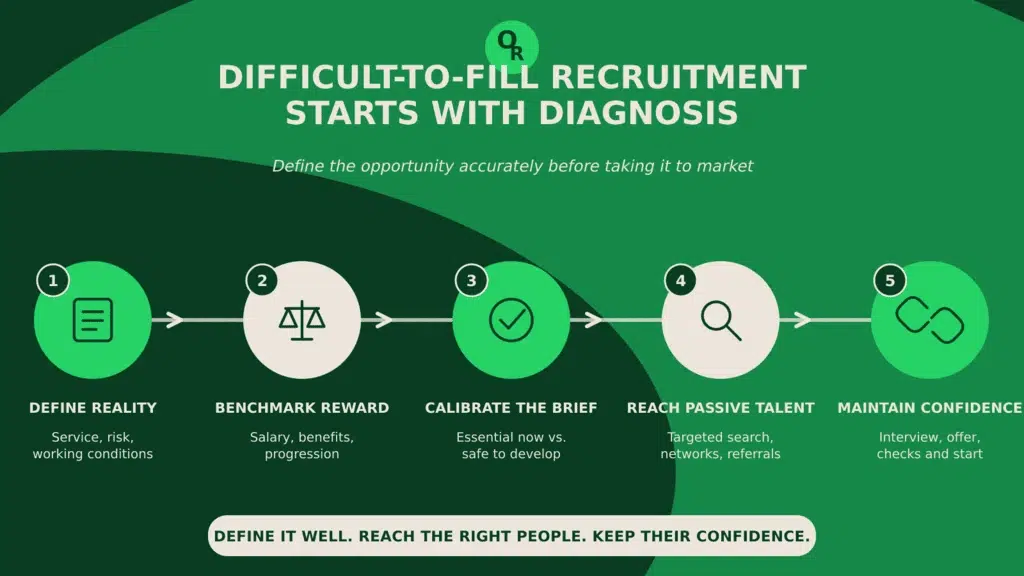
Advertising alone is often insufficient for specialist and leadership appointments. Olive Recruit therefore begins with a detailed vacancy consultation covering the service, regulatory responsibilities, essential experience, salary, benefits, team dynamics and immediate challenges. This calibration separates first-day requirements from skills that can be developed safely, while identifying whether the title, scope, interview process or employment package could reduce candidate interest. Olive Recruit then combines targeted advertising with proactive searches across specialist networks, referrals, LinkedIn and leading job boards.
Before presenting anyone, the team explores their qualifications, motivations, working preferences, values and reasons for considering the opportunity. Support continues through interviews, feedback, offer discussions, notice periods and pre-employment checks, helping both sides maintain confidence and momentum. Published partnership evidence demonstrates the potential result of this approach. According to Olive Recruit’s case study, the agency accounted for 82.35% of Catalyst Care Group’s placements in 2024 across clinical and corporate roles. More recently, Olive Recruit supported recruitment into specialist Continuous Improvement positions, including PBS and in-house training roles.
For positions requiring specialist expertise, regulatory confidence and the right values, successful recruitment is not about generating more applications. It is about defining the vacancy properly, reaching the right people and maintaining confidence through to a successful start.
Recruiting for a Registered Manager, PBS Practitioner, therapist, nurse or another difficult-to-fill social care position? Speak to Olive Recruit before going to market. We can help you assess the salary, refine the brief and build a candidate proposition that reflects both the demands and the value of the role.
You can also explore more Olive Recruit Successful Stories or download the Olive Recruit Salary Guide 2026 for current market benchmarks and wider workforce insight.
