

Who Is Gen Z in the Workplace?
Gen Z refers to people born between 1997 and 2012. In 2026, the older end of this generation is approaching 30, and the younger end is entering the workforce for the first time. We’re looking at roughly 18-29-year-olds who are now occupying entry-level roles, early management positions, and everything in between. They already account for 30% of the UK workforce, and that figure continues to grow.
Gen Z workers grew up with the internet, not as something new, but as something that was simply always there. Online tools, digital communication styles, and instant access to information are not novelties for these digital natives. They are the standard. But being digitally fluent doesn’t mean that they have had it easy. This generation entered the workforce during or just after the COVID-19 pandemic, at a time of economic uncertainty, rising living costs, and a mental health crisis that the UK had already started calling a “burnt-out nation.”
Research from Mental Health UK’s Burnout Report confirms that 91% of UK adults experienced high or extreme stress in 2026, with one in five needing time off work as a result. Generation Z are connected and capable, but they are also the most burnout-aware generation we have seen enter the workforce. That awareness shapes everything about what Gen Z job seekers expect from employers in 2026.
What Gen Z Expects From Employers?
Forget the idea that Gen Z candidates expect employers to provide them with free snacks and extravagant office spaces. Their desires are far more grounded than that, and they are increasingly non-negotiable. Here’s what actually matters to them.
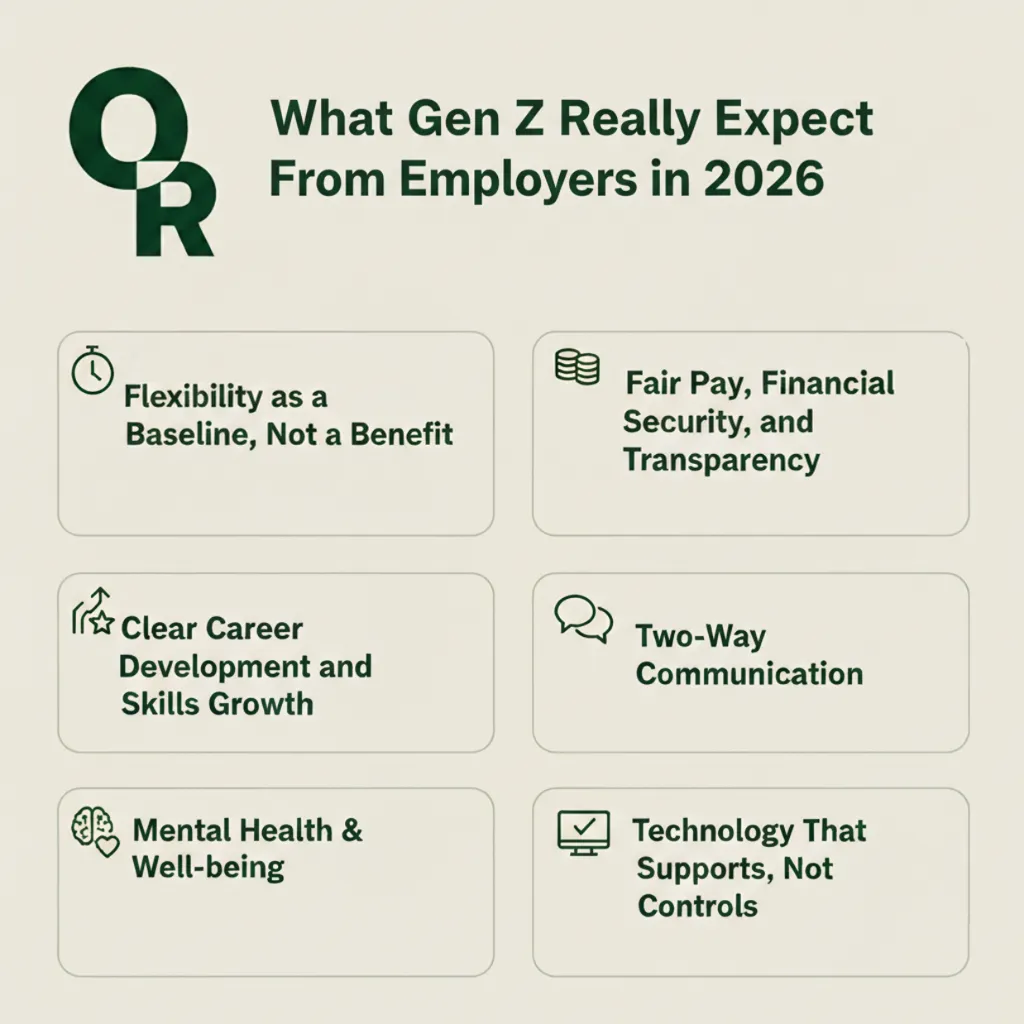
Flexibility as a Baseline, Not a Benefit
Gen Z job seekers do not see flexible working as a reward for good performance or a perk you earn over time. They see it as a standard feature of any reasonable job. Researches show that 73% of Gen Z workers would leave a role that offered no flexible options, as this is one of the top factors that make them feel valued at work. That’s not the same as saying they never want to come into office. What they want is control over when and where they work, not a rigid schedule inherited from a working model designed decades ago. That’s why beware of job ads that say “office attendance 5 days a week,” as they would make it almost impossible to attract Gen Z talent.
Fair Pay, Financial Security, and Transparency
Pay matters. It always was, it always will. No generation values their paycheck less. What Gen Z has added to the conversation is the demand for transparency around it. They want to know what the salary range is before they apply, how pay progression works, and to understand the thinking behind compensation structures, not just be handed a number and told to take it or leave it.
This urgency around pay is not abstract. The cost-of-living crisis has made early careers genuinely difficult, and a significant proportion of UK Gen Z employees report not feeling financially secure. Employers who are open about pay, offer clear salary bands in job postings, and build progression into the role from day one will always have a competitive advantage over those who keep things vague. And bear in mind that companies listing “competitive salary” without any further details will be removed from the “potential employer” list immediately.
Clear Career Development and Skills Growth
Gen Z job seekers focus on growth and continuous learning as much as they focus on their pay and well-being. A large majority would leave a job that offers no real opportunities for advancement. And they can sense really fast if a company has no “room to grow” and no clear growth paths. Have these things covered, and be pretty clear about them, if you would like to have top Gen Z talent knocking on your door:
- A defined onboarding plan from day one
- A named mentor or manager responsible for their development
- A structured review with honest, two-way feedback
- A visible example of someone who joined at a similar level and progressed
Those actions do not require a large budget. They require intention.
Here, it is also worth clarifying the distinction between career development and job title progression. Unlike previous generations, Gen Z talent is more interested in acquiring new skills and broadening their knowledge horizontally rather than focusing solely on vertical career growth to reach leadership positions. We’re talking about two different dimensions and perspectives, so adjust accordingly. Offer stretch projects, cross-team collaboration, mentorship opportunities, or the chance to shadow your best talent from a different role. This approach could be just as motivating as a step change in seniority, and far easier to deliver.
Two-Way Communication
Gen Z have grown up in environments where feedback is instant, and communication is constant. They expect employers to hear them, not just manage them. That means regular check-ins rather than yearly performance reviews, open conversations about how the business is doing, and honest feedback that flows in both directions. This is not about softening every difficult message or avoiding accountability. It is about recognising that when you hire someone and only tell them how they are doing once a year, you have missed eleven months of chances to course-correct, develop, and engage them properly.
Let’s have an example. A Gen Z employee who flags a problem with a process and gets silence in return will not flag it again. They will either work around it or start looking elsewhere. Even if the answer is: “we can’t change that right now and here’s why”, provide it, as it will build something genuinely valuable: trust – the golden currency of every successful communication.
Mental Health & Well-being
It is not just a trend. Younger workers are losing a meaningful chunk of productive time every week to stress, anxiety, and burnout. Not because they are fragile, but because they prefer to have honest conversations about it, unlike previous generations, which were not encouraged to do so. The discrepancy begins when most of them do not feel safe raising this issue at work, discussing their mental health and well-being with their managers. They need to feel assured that this kind of support is not just written in the company values but also lived every day.
Create a culture where talking about stress or burnout is not treated as a weakness or a sign that the young talent is not coping. Gen Z notices quickly when mental health support is genuine rather than just a poster on the wall. And when they sense it is performative, they lose trust fast. Here are some approaches that actually move the needle:
- Bring mental health and well-being to the beginning of each one-to-one. A simple “How are you doing?” at the start of a regular check-in costs nothing and signals that managers see the person, not just the output. Over time, that consistency builds the kind of trust that makes it easier for someone to speak up before things get serious.
- Normalise the conversation from the top. Managers and senior leaders should start talking openly about challenges in one-to-ones. It’s not vulnerability, it’s honesty.
- Offer well-being days without the paperwork. Some companies have started allowing employees to take a day off, just as they can take a sick day.
- Train managers, not just HR. Mental health support is mostly required directly from the direct manager, not in a formal HR setting. Train them to spot the early signs of burnout so they can show truly supportive leadership.
Technology That Supports, Not Controls
Gen Z expect the tools they work with to be functional, up to date, and designed to make work easier. At the same time, they are equally aware of how technologies can be used to monitor and micromanage. They are not opposed to performance metrics, but they do push back against surveillance-style management in which every click is tracked, and every absence is flagged. Technology should help people do better work, not make them feel watched around the clock. Companies that find balance will earn far more loyalty than those that treat each tech as a substitute for trust and direct communication.
What Gen Z Doesn’t Want From Employers?
It is just as useful to understand what Gen Z are walking away from as it is to know what draws them in. The two sides of the picture are equally revealing. Here’s what they are not willing to put up with.
Outdated Workplace Hierarchies
Gen Z are not anti-authority. But they are resistant to hierarchy for its own sake. They do not accept the idea that someone’s opinion carries more weight simply because of a longer job title or more years on the payroll. They want decisions to be explained, not just handed down from the top. They want access to leadership, not a chain of command that takes three weeks to pass information up or down through layers of management.
A flatter, more accessible structure does not have to mean disorganised or chaotic. It means transparent, direct, and built on actual merit rather than seniority alone. Gen Z can see the difference, and so can any employer paying attention to their exit interviews.
Poor Work-Life Balance
Gen Z watched the generation before them run themselves into the ground on overwork and chronic stress, and they made a clear decision not to repeat those patterns. They are not lazy. They are boundary-aware. They know the difference between working hard during contracted hours and sacrificing their personal lives in exchange for a salary. When employers expect Gen Z to answer emails at 10 pm or routinely work unpaid overtime without any acknowledgement, they lose them.
Lack of Transparency
This applies to pay, as already covered, but it extends beyond that. Gen Z candidates want to know what the company actually stands for. They research employers on LinkedIn, Glassdoor, and even on TikTok, before they even apply. They read reviews, listen to current and former employees, and compare what a company claims in its job advert against what they can find out for themselves.
Vague value statements, a visible mismatch between the employer brand and real experiences inside the business, or any sense that important information is being withheld, will push Gen Z toward a competitor without hesitation. For this new generation, transparency is a minimum standard, and companies that fall short will feel that in their applicant numbers.
What Employers Expect from Gen Z Job Seekers
The conversation around Gen Z in the workplace tends to focus on what employers need to do differently. And a lot of that is fair. But the relationship works both ways, and it is worth being honest about what employers are reasonably looking for from Gen Z candidates in return. The expectations, which are not complicated, include:
- Reliability and follow-through. Employers who offer hybrid working, flexible hours, or autonomy over how work gets done are extending a level of good faith. What they need in return is for Gen Z employees to deliver on what they say they will, meet deadlines, and show up, physically or virtually, when it counts. Flexibility is not the same as availability on your own terms only.
- A willingness to learn, not just to be taught. Employers want curious people who ask good questions and are open to learning from colleagues who have been in the industry longer, even if those colleagues work differently from them.
- Communicating back. The two-way communication that Gen Z rightly asks for from their leaders only works if they bring the same openness and proactivity to their side of the relationship. If a deadline is at risk, say so early. If something is unclear, ask. If a project is not going the way it should, flag it.
- Patience with progress. Growth takes time, and employers need people willing to put in the groundwork before stepping into more senior roles. Wanting to progress quickly is healthy, but expecting a leadership role after just six months without the experience to back it up creates friction on both sides.
- Professionalism in the way they show up. It means being present in meetings, responding to messages within a reasonable timeframe, and treating all colleagues with basic respect.
What Happens If Employers Ignore Gen Z Expectations?
Gen Z already make up a significant share of the UK workforce, and that number will keep growing. Replacing an employee is expensive, as recruitment, onboarding, and the productivity gap that opens up every time someone new steps into a role all carry real costs. When you multiply that against a pattern of high turnover among your youngest employees, the financial burden for paying attention becomes very heavy, very quickly.
The skills shortage makes this worse. The UK is already contending with significant gaps across healthcare, technology, social care, and other sectors. When companies fail to retain Gen Z talent, they are not just losing one person. They are losing a pipeline of future team members who would have grown with the business, developed specialist knowledge, and eventually filled roles that are already in short supply. And when the pattern repeats itself over time, the pipeline dries up entirely. Candidates talk to each other, and a company with a reputation for losing young staff quickly will find that reputation arrives before their job adverts do.
The employer brand damage is the quietest consequence but also the most lasting. Gen Z post a lot. They review. A candidate who had a poor experience at your company will tell their network, and many will do it publicly. Glassdoor, LinkedIn, and community forums mean that a reputation for poor management, lack of progression, or disregard for well-being can spread faster than any PR effort can contain it. The companies that are building genuine relationships with Gen Z right now are also building a reputation that will keep attracting good people for years to come.
Conclusion: Gen Z Isn’t Asking for More, They’re Asking for Better
There is a tendency to frame Gen Z’s expectations as demanding or unrealistic. They are not. When you strip back the noise, what Gen Z is asking for is what most reasonable people would want from any employer: fair pay, honest communication, real development opportunities, and a working environment that does not cost them their health.
The difference between Gen Z and previous generations is not that they want more. It is that they are much less willing to accept less. They have seen what chronic overwork does to people. They have grown up in a world where employer reviews are public, and reputations are searchable from a phone. They have too many options to be selective, and they are exercising that right without apology.
Get Gen Z Talent with Olive Recruit
Whether you need to build your strong employer brand, sharpen your hiring process, or start reaching a wider talent pool or a segmented job market, Olive Recruit can help you put the right pieces in place. Provide your Gen Z employees with well-being opportunities, meaningful work, and a place to thrive, and this next generation will reward you with high job satisfaction and retention.
If you’re ready to create a team that reflects where the global workforce is heading in 2026, get in touch with us at oliverecruit.co.uk and let us show how we can help.
