

Why Do Businesses Invest in Talent Acquisition?
Hiring a specialist talent acquisition agency is a strategic choice for businesses that want better hires without stretching their internal teams. Instead of treating agency fees as a one-off cost, many companies now see them as an investment in:
- Faster hiring
- Access to wider talent pools
- Fewer costly mis-hires
A good agency brings sector expertise, market insight, and ready-made networks, so your organisation can reach qualified, often passive candidates that your own adverts would never reach. Leaders free their people to focus on onboarding, development, and retention by outsourcing the time-heavy parts of the recruitment process, such as:
- Sourcing
- Screening
- Shortlisting
- Candidate communication
The Growing Competition for Skilled Talent
Across the UK, employers compete for a limited pool of experienced workers, especially in sectors such as healthcare and social care. NHS forecasts, for example, point to six-figure workforce gaps over the coming years, which puts extra pressure on trusts and care providers to uphold their staffing needs.
Talent acquisition specialists follow these shifts closely, track what competitors offer, and adjust sourcing and messaging so their clients’ needs stay visible and attractive to high-demand profiles.
Talent Acquisition Specialist Job Description
A talent acquisition role incorporates the full hiring lifecycle for specific roles or business areas, from forecasting needs with managers through to offer and onboarding support. Their scope of work includes:
- translating workforce plans into job descriptions,
- identifying suitable channels,
- Creating sourcing strategies,
- Leading the screening process,
- Running structured interviews,
- Tracking results.
Key Responsibilities and Skills of a Talent Acquisition Specialist
A Talent Acquisition Specialist plays a key role in attracting, assessing, and hiring top talent for clients, serving as the link between hiring managers, candidates, and the wider labour market.
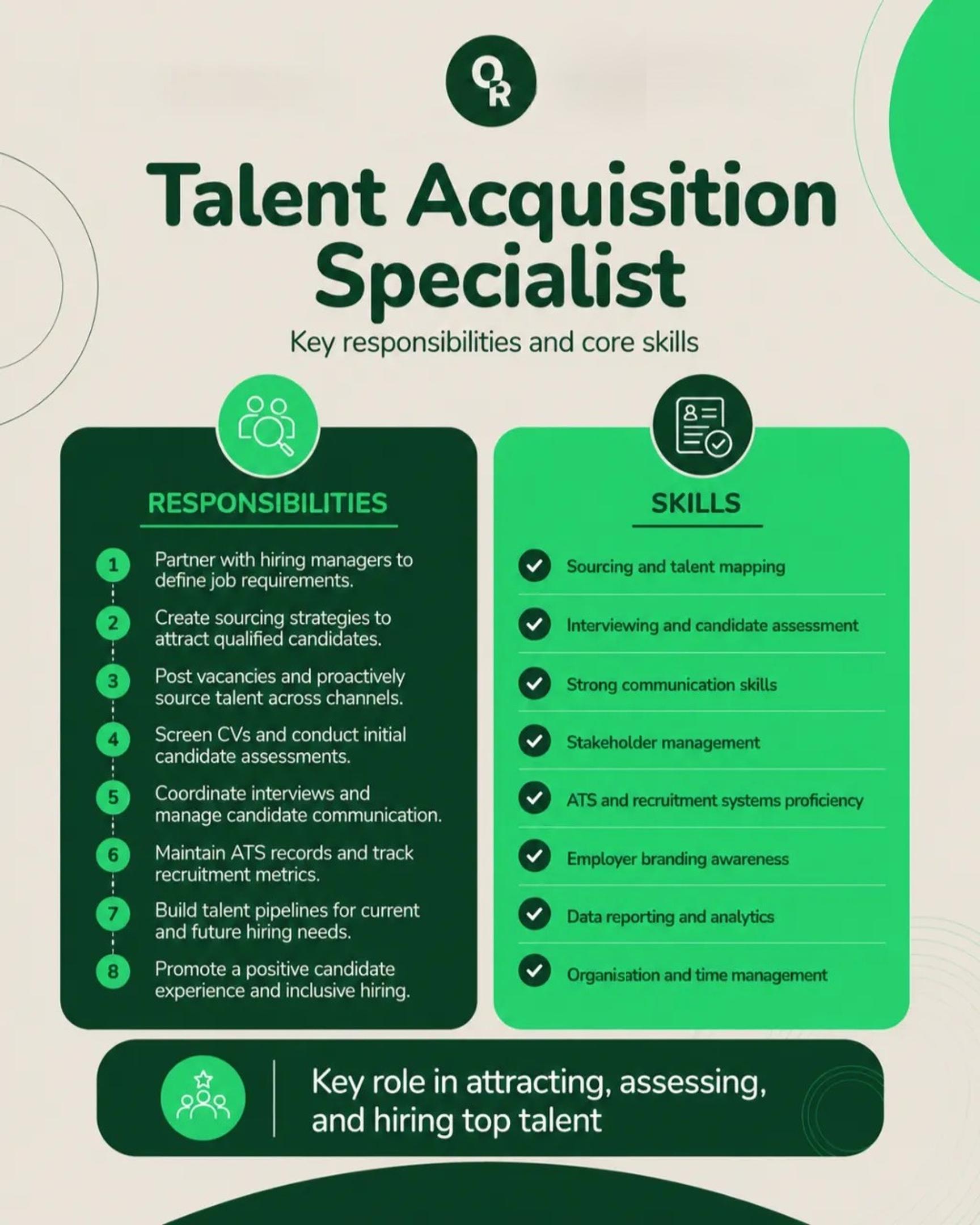
On a day-to-day level, they are responsible for the full hiring process. They partner with hiring managers to clearly define job requirements, then create sourcing strategies that attract qualified candidates rather than a random mix of applications. They post vacancies and proactively search for suitable candidates across different channels, from job boards to professional networks, before screening CVs and running initial candidate assessments. Once a shortlist is in place, they coordinate interviews, manage candidate communication, maintain relationships with potential candidates, and track key recruitment metrics. Alongside live roles, they also build talent pipelines for current and future hiring needs and make data-driven decisions to promote a positive candidate experience and inclusive hiring practices at every stage.
To handle this scope, Talent Acquisition Specialists rely on a mix of technical and interpersonal skills, often referred to as hard and soft skills. Core strengths include candidate sourcing and talent mapping, as well as conducting interviews and candidate assessments to measure both capability and fit. They use data reporting and analytics to refine their approach over time and apply strong organisational and time-management skills, ensuring every campaign moves forward without candidates feeling ignored or left behind.
Qualifications and Backgrounds
There is no single “perfect” route to becoming a qualified talent acquisition specialist at an agency, which makes it a good option for those who enjoy people-focused work and are happy to learn on the job. Many agency specialists start out as recruiters, junior recruitment consultants, or HR assistants and grow into talent acquisition roles as they learn how to build client relationships and support candidates through every stage of the hiring process. Others move sideways from team leader roles in sales or operations, bringing strong communication skills and a solid grasp of how businesses actually go through the hiring process.
On paper, employers often ask for a degree in Human Resources management, business, psychology, or a related subject, but they tend to care more about evidence that you can manage a full recruitment process from vacancy through to offer. Experience using recruitment and sourcing tools, confidence with LinkedIn and a basic understanding of employment law and data protection are usually more valuable than a long list of formal certificates. Short courses in interviewing, employer branding, or diversity and inclusion can add weight, but your track record with candidates and hiring managers will be what really opens doors in this field.
Industries That Olive Recruit’s Talent Acquisition Specialists work with
Industry trends state that talent acquisition specialists are most needed where managers lack the time or expertise to handle everything on their own. This is the kind of hiring Olive Recruit supports every day across the UK:
- Healthcare and Social Care
Hospitals, clinics, care homes, and community providers face ongoing shortages and high demand. Talent acquisition specialists here balance regulatory requirements, shift patterns, and the need for people with strong values and clinical skills.
The Role of Technology in Talent Acquisition
Technology has moved from being a “nice to have” to the backbone of modern talent acquisition. Most agencies now work with an Applicant Tracking System (ATS) that stores vacancies, applications, interview notes, and hiring decisions in one place, reducing admin, improving compliance, and making it far easier to see what is working in real time. Used well, an ATS also improves the candidate journey by supporting structured updates, standard templates, and clearer timelines.
On top of that, AI tools and recruitment automation handle tasks like CV parsing, basic screening questions, and interview scheduling, freeing recruiters to spend more time in conversations rather than in their inboxes. Social media and digital sourcing add a final layer, allowing talent acquisition specialists to meet candidates where they already spend their time: on LinkedIn for professional moves, on job boards such as CV Library and Indeed, and in Facebook groups and niche online communities for specific sectors or locations. The most effective specialists combine these tools with human judgement, so technology speeds things up without turning hiring into a cold, automated experience.
A Typical Day for a Talent Acquisition Specialist
One of our Talent acquisition specialists, Ana Bojadzi, shared how she spends a typical working day.
“No two days are ever the same in talent acquisition. My role focuses on connecting skilled professionals with opportunities across the UK health and social care sector, with a particular emphasis on mental health services.
A typical day involves sourcing and engaging with candidates for a variety of positions, including Registered Managers, Nurses, Care Coordinators, and other specialist roles. I conduct interviews to understand candidates’ experience, career goals, and motivations, while supporting them throughout the recruitment process and keeping them informed at every stage.
Alongside candidate engagement, I work closely with clients to understand their staffing requirements, service needs, and organisational culture. This collaboration enables me to identify professionals who not only have the right qualifications and experience but are also the right fit for the team.
Whether I’m speaking with a candidate about their next career move or partnering with a client to solve a recruitment challenge, my focus is always on building strong relationships and helping deliver high-quality care through exceptional people.”
Why Talent Acquisition Specialists Are Important to Businesses
- Improving Quality of Hire
Talent acquisition specialists in agencies spend every day mapping markets, speaking to candidates, and understanding what “good” looks like in different roles, which gives them a sharper view of quality than most in-house teams can maintain on their own. They pre-screen, interview, and reference-check before a CV ever reaches the hiring manager, so you only meet people who already match the core skills, culture, and salary expectations you agreed at the briefing stage. Because agencies work across many vacancies and clients, they can benchmark against wider market data and quickly spot when a profile is genuinely strong rather than just the best of a weak shortlist. - Reducing Staff Turnover
A good agency specialist invests time in understanding your culture, management style, and development opportunities, then tests these points with candidates to avoid matches that look fine on paper but would never last beyond probation. By aligning expectations on both sides and challenging poor fits early, agency recruiters help you avoid the expensive cycle of quick hires who leave within months, thereby supporting steadier teams and lower overall turnover. - Supporting Business Growth and Culture
Agency-based talent acquisition specialists give growing organisations flexible capacity: they can ramp activity up or down as hiring peaks change without you needing to build a large internal team. They also bring insight from other clients in your sector, sharing what competitors are offering, which skills are emerging, and how employer branding is landing with candidates, so your hiring supports both business plans and the culture you want to build. Over time, this partnership helps you assemble teams that not only meet targets but also reflect the values, behaviours, and service standards your organisation is known for.
Talent Acquisition Shapes the Future Workforce
Every vacancy filled today shapes what a company will look like in a few years’ time, which is why talent acquisition is often described as a strategic function rather than a pure back-office task. By defining hiring criteria, choosing sourcing channels, and influencing selection methods, talent acquisition specialists have a quiet but powerful say.
For many companies, partnering with a specialist recruitment agency is the most practical way to access this level of talent acquisition expertise without building a large in-house team. This way, Olive Rectuit acts as an extension of your organisation, bringing sector knowledge, technology, and tested processes to attract, assess, and secure people who will support your plans now and in the years ahead.
Talent Acquisition with Olive Recruit
Working in Talent Acquisition at Olive Recruit means being part of a specialist team dedicated to supporting the UK health and social care sector. As a small recruitment agency, we take a personalised approach, building genuine relationships with both candidates and clients rather than treating recruitment as a numbers game.
We support providers across mental health, learning disabilities, autism, and supported living services, recruiting for a range of positions from frontline clinical professionals to leadership roles. By taking the time to understand each client’s needs and every candidate’s aspirations, we aim to create successful, long-term matches that positively impact the people receiving care.
At Olive Recruit, talent acquisition is about more than filling vacancies. It’s about helping organisations strengthen their services and supporting dedicated professionals in finding roles where they can thrive and make a meaningful difference in people’s lives.
Contact us today for guidance on your next talent acquisition role or to discuss how we can support your company’s hiring plans.
