

What Is a Job Requisition?
A job requisition is a formal request submitted by a hiring manager or department to obtain approval to fill a new or vacant position. Think of it as the internal authorisation document that says, “We need to hire someone for this role, and here’s why.” It’s typically created before a job description or job posting and serves as the foundation for the entire recruitment process.
People outside the HR department often see job requisitions as just a formality, another administrative task. But it certainly is more than that. Once it’s adequately done, filling out a job requisition form lays the groundwork for a successful future hire, by:
- Documenting the business case for a hire
- Securing the budget to be approved quickly
- Clarifying reporting structures
- Setting expectations for the role before any external recruitment process begins
The Purpose of a Job Requisition in Recruitment
Job requisitions serve several critical purposes beyond simply obtaining permission to hire.
First, they formalise the hiring need. Rather than approaching the HR team with a vague request, a structured requisition process forces companies to think through exactly why a position is needed and what problem it solves. This prevents impulsive hiring decisions and ensures new roles align with organisational strategy.
Second, requisitions provide budgetary control. One of the most essential details of any job requisition is the salary range and the budget justification. This ensures that hiring decisions don’t exceed departmental budgets and that the finance department can plan accordingly. Without this step, companies risk uncontrolled spending on compensation and onboarding costs. The job requisition template also documents whether a position is truly new or a replacement, which affects budget forecasting.
Third, job requisitions create accountability and legal protection. By documenting the position requirements, qualifications, and reasons for hiring, companies have a clear record in case questions ever arise about discriminatory practices or hiring decisions. This documentation is crucial for regulatory compliance and demonstrates that the company followed fair, consistent hiring procedures. Additionally, each approved requisition is assigned a unique job requisition number, which tracks the position through the entire hiring lifecycle, from approval through recruitment, selection, and onboarding.
Job Requisition vs. Job Description
These two documents are often confused, but they serve different purposes in the hiring process. A job requisition form template is an internal authorisation document that makes the business case for filling a position. It focuses on why you need to hire and includes information like budget, hiring justification, and reporting structure. The tone is formal and aimed at internal decision-makers.
On the other hand, a job description is an internal document that outlines the job’s responsibilities. It specifies the daily duties, required qualifications, skills, experience, and what success in the role looks like. In terms of timing, the job description comes second in the process. This sequence ensures budget and organisational alignment before investing time in crafting a detailed role specification.
To get a clear idea of their difference, compare these sentences: “We need to hire a Marketing Manager because our team has grown and we need someone to lead our content strategy” vs. “The Marketing Manager will oversee social media campaigns, manage our blog, lead quarterly content planning, and report to the Head of Marketing.”
Job Requisition vs. Job Posting
While a job requisition and a job posting both relate to hiring, they exist at different stages. A job posting is an external advertisement for a job vacancy, published on job boards, the company website, LinkedIn, or other recruitment channels. Chronologically, it comes at the end of the line, following the job requisition and job description, culminating in a job posting for public distribution.
The key differences lie in the audience and tone. A job requisition is an internal, formal process. A job posting is external and designed to attract and sell the role to potential candidates. Job postings often have a more engaging, conversational tone and emphasise company culture, benefits, and why someone should want to work there. The requisition includes information such as budget codes and hiring justification that never appear in a public announcement.
When a Job Requisition Is Needed
When creating a new position.
If your department heads are looking to expand the team or identify a need for a role that doesn’t currently exist, a requisition formally documents why the new role is necessary, how it fits into the team structure, and its cost. This is especially critical for startups or fast-growing companies making their first hires in a particular function.
When replacing someone who left.
If an employee departs and you need to backfill their role, a requisition is still required. This isn’t just a bureaucratic step. It is an opportunity to reassess whether the role still needs to exist in its current form, whether responsibilities have shifted, or whether compensation should be adjusted based on market conditions. Sometimes, when completing a job requisition form, companies realise they can reallocate that person’s work to existing staff, eliminating the need to hire.
When restructuring or reorganising.
If departments are merging, roles are changing, or the reporting structure is shifting, requisitions help document these changes and ensure new employees align with the revised organisational structure.
Many companies require a requisition process for all new hires, whether permanent or temporary. Without this formal step, hiring becomes reactive and uncontrolled.
Key Components of a Job Requisition
A complete job requisition includes several essential elements. While formats vary by organisation, most standardised requisitions capture the following information:
- Job title and department. A clear, specific title and the department or team the position sits in.
- Hiring manager and recruiter assignment. The name and contact information of the person who requested the hire and who will oversee recruitment.
- Employment type and location. Whether the position is full-time, part-time, temporary, or contract, and where work will be performed (office, remote, hybrid).
- Salary range and budget. The proposed compensation (hourly rate or pay grade) and confirmation that funding exists within the budget.
- Headcount justification. A clear explanation of why this hire is needed and what problem it solves.
- Target start date. The desired start date for the new hire, which helps set recruitment timelines.
- Job description. Either a complete job description attached or a summary of key responsibilities and required qualifications.
- Reporting structure. Who the new hire will report to and any direct reports they may have.
- Reason for hiring. Whether this is a new position, a replacement, or backfilling for an internal move.
- Qualifications required and preferred. The essential must-haves versus nice-to-haves in terms of education, experience, certifications, and skills.
Each of these components ensures that when a requisition moves through approval workflows, all stakeholders have consistent information and can make informed decisions.
Job Requisition Process
The path from identifying a hiring need to launching recruitment typically follows the following five steps.
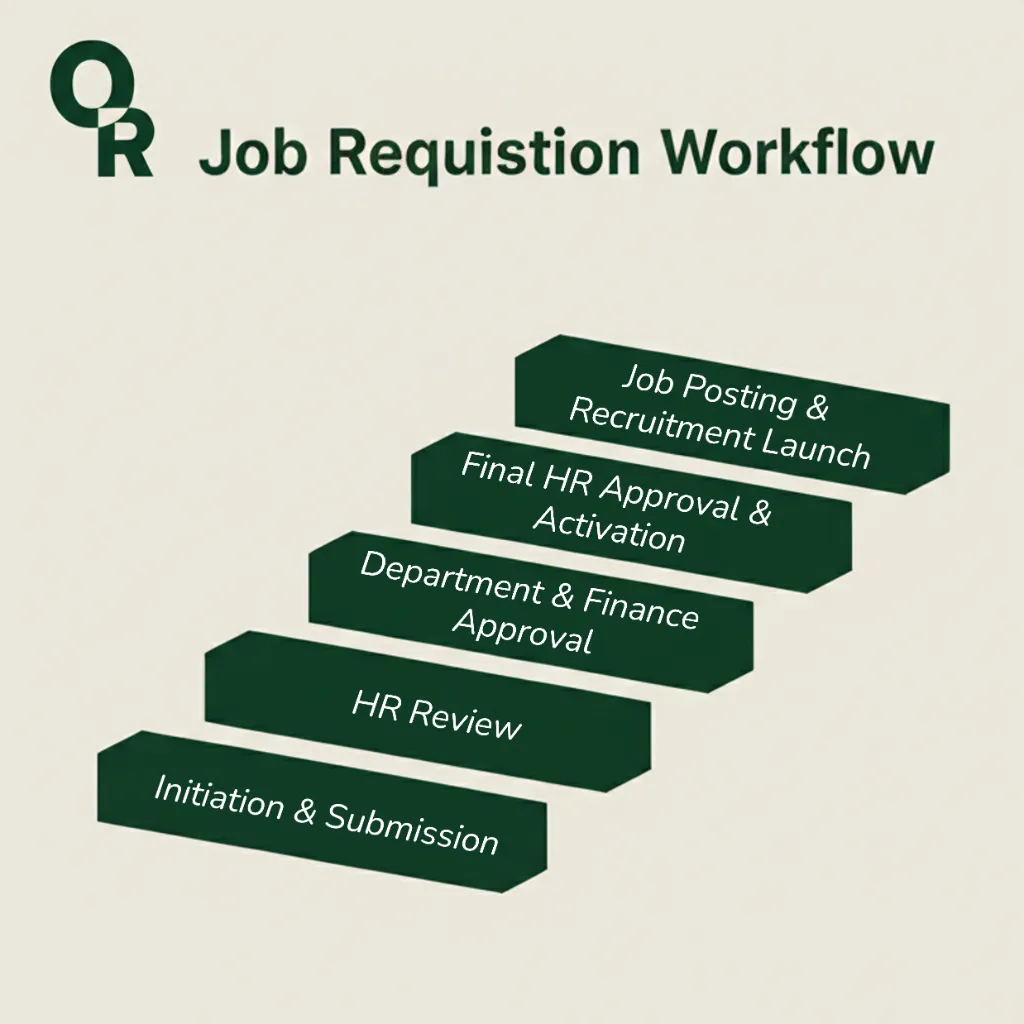
- Initiation and Submission.
The hiring manager identifies the need and completes the job requisition form, often using a standardised template provided by HR or an Applicant Tracking System (ATS). The form is submitted to the hiring manager’s immediate supervisor for initial review, then forwarded to HR. Many companies now use online requisition systems that send forms containing key information automatically to the next approver. - HR Review.
The HR department reviews the requisition to ensure all required information is complete, that it aligns with organisational policies, and that the position is strategically sound. HR may ask clarifying questions about the requisition reasons or request additional documentation at this stage. This review typically happens within a few days, depending on the company’s workload. - Department and Finance Approval.
The requisition moves to the department head and executive team for approval, confirming that the hire aligns with departmental priorities. Finance or the accounting department then reviews the budget allocation to ensure sufficient funding is available. This is where requisitions are sometimes denied if budget constraints exist or if the job role doesn’t align with the company’s priorities. - Final HR Approval and Activation.
Once all approvals are obtained, HR professionals finalise the requisition and assign it a unique job requisition number. This number becomes the tracking code for the entire hiring process. At this point, a job intake meeting typically occurs between HR and the hiring manager to fine-tune the job description, discuss the recruitment strategy, set timeline expectations, and address any remaining questions, after which they provide final approval. - Job Posting and Recruitment Launch.
The finalised job description is adapted into a job posting and an advert and published on the appropriate channels. The approved requisition is assigned to a recruiter or recruitment team, who can now actively source and screen candidates. The time from submission to launch varies depending on complexity, approval chains, and workload.
Get Qualified Staff Through Olive Recruit
Creating a solid job requisition is just the beginning. Once your requisition is approved and your job description is posted, the real work of finding the right person for the vacant role begins. This is where many recruiters need expert support.
Whether you’re located in Bristol or anywhere across the UK, if your requisition approval process is solid but your recruitment and talent acquisition results aren’t matching expectations, or if you’re struggling to fill critical roles, Olive Recruit helps companies streamline the journey from requisition to hire. Get in touch with our dedicated team of experts. We’re expecting you.
