

What Are Recruiting Chatbots?
Recruiting chatbots are conversational artificial intelligence (AI) tools designed to interact with candidates throughout the hiring process. We could imagine them as digital receptionists who never sleep, never show excessive emotions, and never forget to send a follow-up message. They provide a seamless candidate experience sitting on company websites, career pages, or other platforms where job seekers typically land, ready to engage them in conversation.
The technology behind recruiting chatbots ensures a seamless candidate experience by using natural language processing to understand candidate inquires and respond with relevant information. More sophisticated versions can ask screening questions, assess qualified candidates, provide and gather feedback, and schedule and conduct interviews. They use machine learning to learn from each interaction and improve, becoming progressively better at matching candidate roles, learning about candidates’ behaviour and identifying potential red flags.
Why Companies Are Turning to Chatbot Recruitment?
Your recruitment process doesn’t need to consume valuable time in tasks that don’t require the judgment or experience of a qualified recruiter. That’s where AI-powered recruiting chatbot automations come in. To substitute tasks that drain resources and frustrate candidates, particularly top talent who have multiple opportunities.
Let’s put it this way: your recruiting process shouldn’t be about spending valuable workday hours answering whether the role is remote. When you’re hiring for multiple positions or in competitive markets where talent acquisition is competing for just a few well-known candidates, every hour saved on administrative work is an hour they can spend keeping the potential candidates engaged. It’s efficiency freed up for what matters: human interaction, connection and judgment.
How Recruiting Chatbots Work?
Recruiting chatbots operate through a series of conversational AI flows. When a candidate arrives at a career page or clicks a job posting, they are typically greeted by a chatbot that asks whether they’d like to proceed with the application process or have any questions about the role.
The chatbot asks predefined screening questions tailored to the specific role. For a software developer position, it could be: “How many years of experience do you have with Python?” or “Have you worked with cloud-based infrastructure?” Other types of questions include availability dates, willingness to work shifts, or even salary ranges. Job candidates answer all these questions through the chat interface, and the chatbot’s algorithm evaluates their responses against the job requirements.
Behind the scenes, the chatbot uses decision trees and AI scoring systems to determine next steps. If the candidate’s answers suggest they’re a strong match, the chatbot might proceed to more detailed questions about their background, skills, and career goals. If answers suggest a poor fit, the chatbot politely thanks them, explains why they weren’t selected, and even offers alternative roles that might suit them better. Once a chatbot has gathered sufficient information, it typically hands off candidate responses to a human recruiter or directly to hiring managers through an Applicant Tracking System (ATS).
Pros of Recruiting Chatbots
Now, let’s dive into the positive reasons why your company should implement its own AI chatbot.
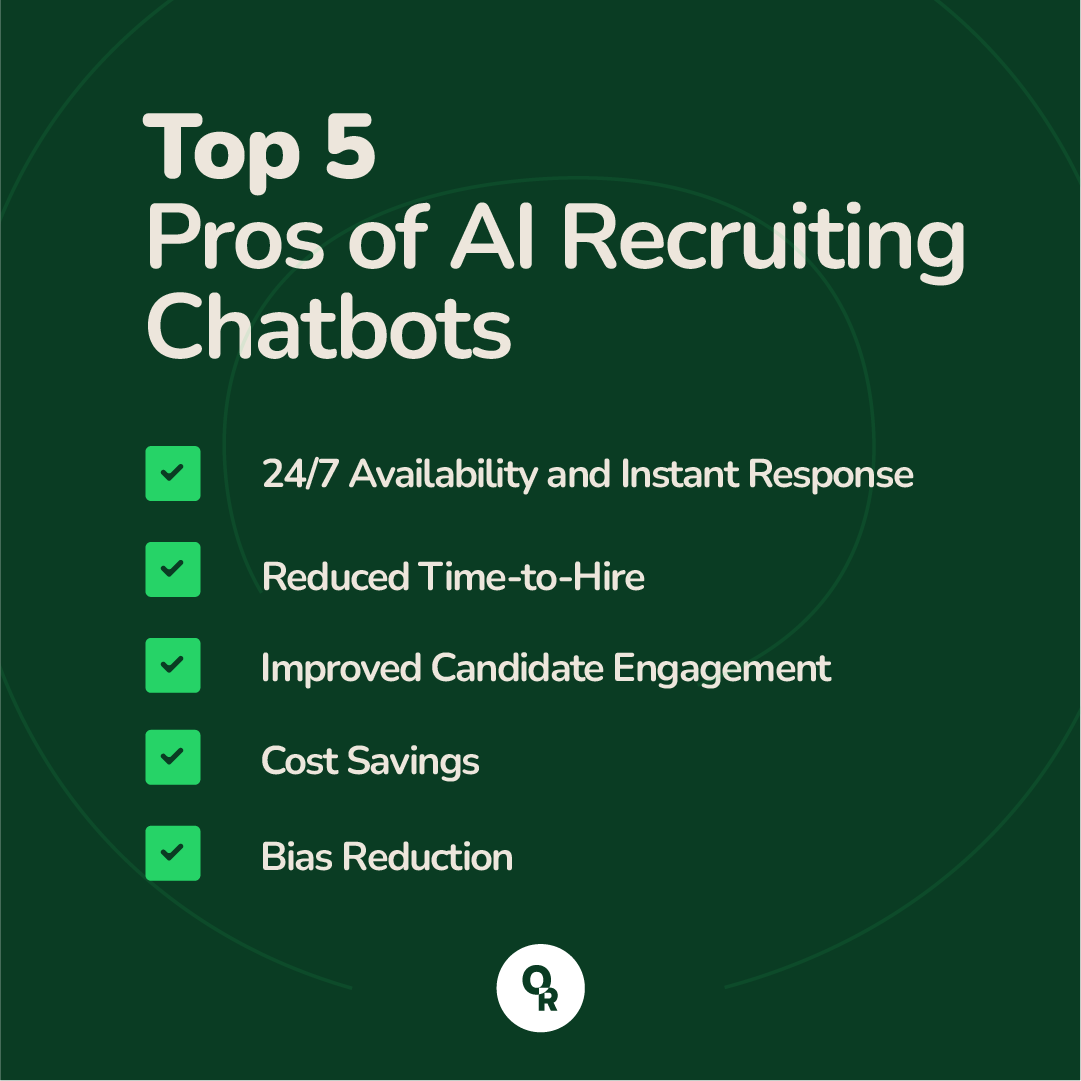
24/7 Availability and Instant Response
First and foremost, availability. Research shows that candidates who receive immediate responses to their inquires are significantly more likely to remain engaged with the hiring experience and develop a positive first impression of your company culture. It’s simple: when a candidate applies for a role and receives a message within minutes, even if it’s from an AI chatbot, they feel valued and kept in the loop.
Reduced Time-to-Hire
The speed matters most in competitive talent markets. A developer or nurse shortage is a good example: candidates with in-demand skills often receive multiple offers. The company that moves fastest usually wins. If you can identify qualified candidates and schedule their first interviews within 48 hours while competitors without an AI chatbot take a week, you’ve won before others have even started.
Improved Candidate Engagement
Chatbots are keeping candidates engaged throughout the entire hiring process. They send regular updates, answer questions, and guide candidates through each step. A candidate knows what to expect, when to expect it, and has a point of direct contact, even if it is only an AI, whenever they need information. After all, it’s a silent treatment against an AI answer – who would you choose?
Cost Savings
Opponents of AI chatbots say that this is a costly investment. But is it? Can you compare a several-thousand-pound one-time upfront payment to the annual cost of £30,000 for your recruiter, who is constantly unfocused and spends at least 25% of their time pre-screening candidates? That’s £7,500 per recruiter per year cost. And where is the interview scheduling time, all that back-and-forth mailing about finding a suitable time slot, one that an AI chatbot could solve in an instant? You could pay off your AI chatbot in a matter of months, not years.
Bias Reduction
Chatbots ensure candidates receive the same standards. They leave no room for favouritism, discrimination, or unconscious biases based on age, gender or country of origin. They assess skills and qualifications objectively, reducing the biased judgment that human recruiters can introduce during the candidate screening and interview process.
Cons of Recruiting Chatbots
Up to this point, things seem to be going well. But chatbots have their own drawbacks as well. Companies also need to understand the cons of recruiting chatbots, so they can see the whole picture before deciding whether they are the right solution to their problems.
Lack of Human Touch
Recruitment is fundamentally about human connection. Candidates are anxious about their future, and most are not yet ready for the new, contactless recruitment process. Applicants want to see who is on the other side, will they get along, and you cannot get those hints from empty words on the screen. You need faces – warm and welcoming ones.
Inability to Assess Soft Skills
An AI chatbot can recreate recruitment workflows, learn everything about candidate profiles, and answer all candidate questions. Still, it cannot pick up on tone, confidence level, or whether an answer is genuine or rehearsed. Soft skills assessment requires nuance that current technology simply doesn’t possess. Be mindful, and if it is not a simple technical role you’re looking for, don’t rely entirely on Artificial Intelligence.
Technical and Implementation Challenges
Let’s imagine that you finally decided to use AI chatbots. In theory, they look great, but what’s their practical side? Depending on the service provider, you may encounter errors. As with all software solutions, they come with a price. Without proper customer service, your recruitment chatbots don’t stand a chance. There will always be issues and wrong answers, especially in the beginning. And what’s more, you need a dedicated person from your company’s side, someone who could configure the screening questions, set up decision trees, integrate with your systems, and finally train the chatbot. This definitively takes time and resources.
Negative Candidate Experience
If not correctly configured, a poorly functioning AI-powered chatbot could damage not only the candidate’s experience but also your employer brand. Good news spreads fast; however, bad news spreads publically even quicker. That is why it is crucial to double-check the entire chatbot hiring workflow before delegating your trust to it, rather than to your experienced recruiting team.
How to Balance Automation with Humanity?
Drawing our evidence from this research, the best approach lies somewhere in between. Companies that win on both efficiency and candidate experience don’t choose between chatbots and human recruiters. They integrate them both into their recruitment strategies.
Human interaction is reserved for moments that matter: initiating conversations with active and passive candidates and setting a warm, humane tone in the right beginning. Then it is OK for the artificial intelligence to handle the technicalities until the interviews take place. Then, again, a welcoming face is needed to ask questions, build rapport, and in the end, close the deal.
On the other hand, chatbots can help with clearly defined screening questions, such as years of experience, technical certifications, specific skills, and availability. They work well for scheduling interviews, tracking application status, and sending updates. But remember to be transparent about which step of the process is performed by AI or by a human.
When Is a Recruiting Chatbot the Right Choice?
We shared our positive and negative thoughts on using AI-powered chatbots for your recruitment needs. So it’s time for conclusions.
Chatbots are genuinely helpful, and that’s a fact. They are also great for doing candidate pre-assessment, engaging candidates during the interviews and keeping them in the loop afterwards. However, they do their best work only in specific contexts:
- High-volume vs. single-position hiring. If you’re hiring 50+ people across multiple roles annually, the efficiency gains and cost savings justify the investment.
- Big companies vs. small ones. Higher numbers require higher speed. And chatbots are best in this. On the other hand, the flexibility that smaller companies provide is best kept without technological interference.
- Specialised vs. generic roles. Go for the recruitment chatbot if you require higher-frequency, lower-retention roles. Stick with your human recruitment team if you’re looking for a deeper assessment, including soft skills and cultural fit.
FAQs
Continue reading if you still have unanswered questions about recruiting chatbots.
Do Recruiting Chatbots Really Improve Hiring Efficiency?
Yes, numbers confirm that recruiting chatbots improve operational efficiency by handling repetitive tasks. However, efficiency isn’t completely guaranteed. If not correctly configured and supervised by a human recruiter, it can bring many downsides. And also remember, speed and quality are inversely proportional – if the speed goes upwards, it’s inevitable for the quality of hires to go downwards, without enough human intervention.
Are Chatbots Safe for Handling Candidate Data?
It’s a matter of the service provider’s choice and your IT implementation. REputable recruiting chatbots with enterprise-grade security and encryption are reasonably safe and comply with UK data protection regulations, including the Data Protection Act 2018 and UK GDPR requirements. Always ask for verified security credentials before implementation, and be transparent with applicants about the chatbot’s data collection and obtain their consent.
Can Chatbots Replace Human Recruiters?
No, not entirely, and most evidence suggests they shouldn’t. Chatbots are tools that only enrich recruiting, and not replace it. The future isn’t recruitment without humans. It’s recruitment where humans focus on what they do best, rather than on what machines do better.
Choose Olive Recruit as your Recruiting Partner
Olive Recruit welcomes companies with diverse recruitment workflows across the UK. Our recruitment agents can adapt to your recruiting process and candidates’ preferences, whether or not you use AI catbots.
Let’s make your candidate’s job search faster and easier together – get our recruitment professionals’ help and support here.
